Purpose
Develop an international framework for identifying how institutional decisions and systems affect disabled people, how applicable duties are implemented, and how foreseeable disability-related harm can be prevented.
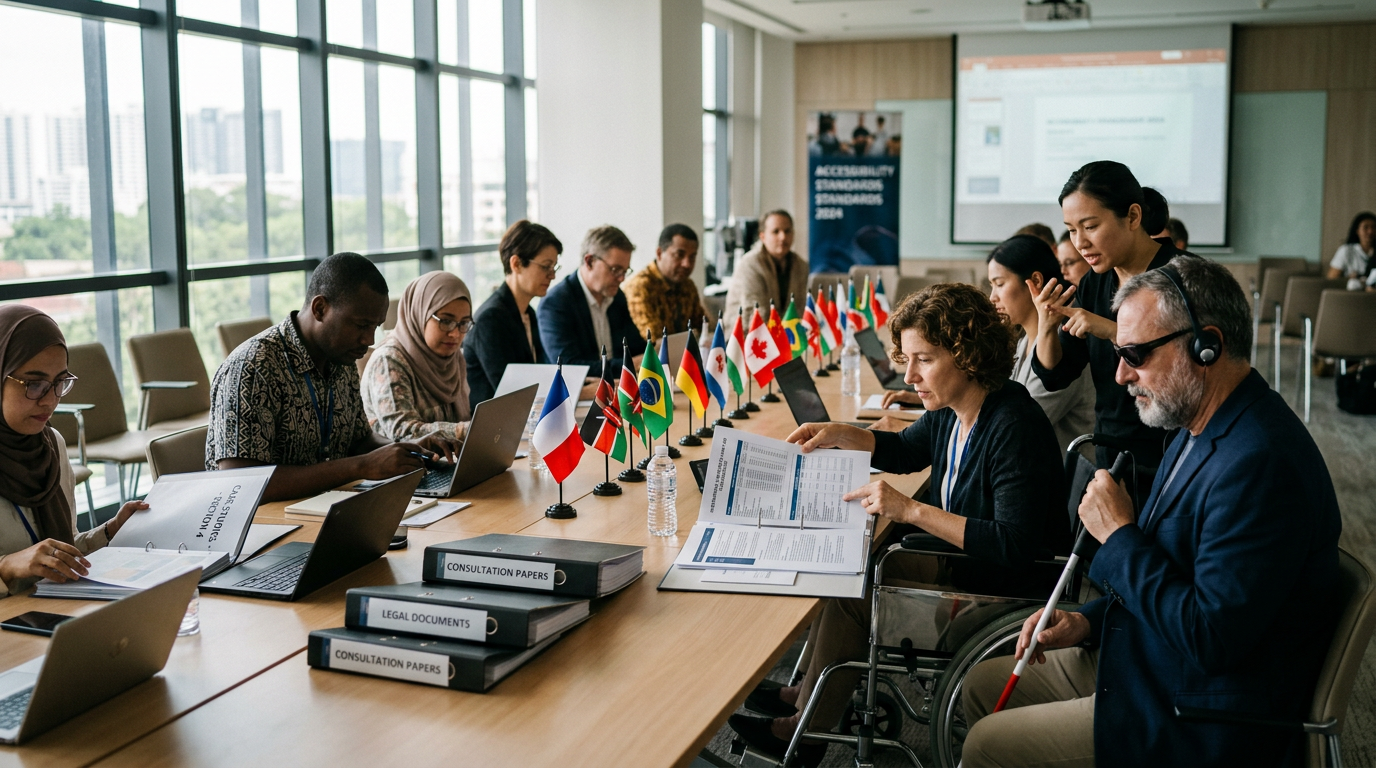
Commander's intent
CADRE International is an evidence-led coalition examining how public institutions, private-sector organisations, and health and social care systems anticipate disabled people's requirements and prevent foreseeable harm — comparing practice across jurisdictions while respecting local duties and legal context.
What we are here to do, how we will do it, and what success looks like.
Develop an international framework for identifying how institutional decisions and systems affect disabled people, how applicable duties are implemented, and how foreseeable disability-related harm can be prevented.
Examine lived experience alongside law, policy, institutional records and documented cases. Compare practice across sectors and jurisdictions without treating different legal systems as interchangeable. Develop proposals for anticipation, access, prevention and accountability.
Institutions identify and address foreseeable disability-related barriers through ordinary governance, planning and service design. Responsibility for prevention is visible, assigned and open to review.
CADRE means Coalition for Anticipatory Duties, Rights and Equality. CADRE International is the proposed comparative and international framework of the coalition.
Founding principle
Responsibility for preventing foreseeable disability-related harm belongs within institutional planning, governance and service design. It should not rest chiefly on disabled people having to identify, explain and repeatedly contest avoidable barriers.
Three areas of scope
The work brings disabled people, representative organisations, researchers, practitioners and relevant institutions into a shared programme of evidence, analysis and practical proposals.
National, regional and local authorities, public agencies, regulators and other public bodies.
Examine policy, administration, commissioning, procurement, public environments and service interfaces.
Companies, employers, businesses, landlords, insurers, banks, suppliers, contractors, technology providers.
And any organisation whose products or services affect disabled people.
Health and care commissioners, providers and regulators across public, independent, private and voluntary provision.
Including primary, community, hospital, mental-health, adult and children’s social care, rehabilitation and related support.
Three programme levers
Together they connect anticipatory practice, continuing organisational change and workforce capability.
Anticipatory Duties, Access, Prevention and Transparency. Map how decisions, systems and services affect disabled people; agree intended outcomes; assign actions and accountability; test changes; and review whether they reduce barriers and foreseeable harm.
Continuously identify emerging risks, policy and technology changes, evidence and lived-experience insights. Use horizon scans to set priorities, develop and test improvements, and update practice as conditions change.
Develop role-specific standards and learning, certify demonstrated competencies, and provide accessible refresher courses. Keep learning current through evidence, lived experience, evaluation and changes in duties and practice.
First programme lever
Anticipatory Duties, Access, Prevention and Transparency
ADAPT translates evidence into system mapping, agreed outcomes, assigned actions, testing and review — with each application grounded in the duties and institutional context relevant to that jurisdiction.
Identify requirements and foreseeable risks before barriers cause harm.
Make communication, services and participation usable in practice.
Change the organisational conditions that create or compound barriers.
Make decisions, ownership, progress and effects clear and open to review.
A typical engagement runs for about 12 weeks, then implementation and review.
Commission and protect
Agree scope, sponsor, decision rights, access, evidence handling and baseline.
Listen and frame
Set the question with disabled people and staff; surface incidents, uncertainty and missing voices.
Map the system
Trace the person’s journey and decision chain; identify barriers, harm and responsibility.
Set the intended state
Describe good practice; agree priorities, outcomes and unresolved decisions.
Design the change
Co-design actions across people, processes, culture, environment and technology.
Implement and test
Run change cycles, test with affected disabled people, record effects and resolve blockers.
Assure and sustain
Review outcomes, assign ongoing ownership, report residual risks and set the next review.
How change is designed
People · Processes · Culture · Environment · Technology
Horizontal in inquiry. Accountable in authority and follow-through.
Geographic and legal scope
CADRE International considers duties and practice at national, regional and international levels. The initial comparative framework includes Europe and the Western Hemisphere, alongside universal international human-rights instruments. Further regional analysis can be developed as priorities and evidence are established.
Domestic legislation, policy and administrative arrangements.
Identify the relevant state, territory, organisation, activity, decision-maker and jurisdiction.
Relevant European Union law and institutions; Council of Europe instruments, including the European Convention on Human Rights (ECHR).
Treat EU law and the Council of Europe ECHR system as distinct frameworks.
Organization of American States (OAS) and its Inter-American human-rights system, including the Inter-American Commission and Court of Human Rights.
Identify applicable instruments and the jurisdiction of the relevant regional body.
United Nations Convention on the Rights of Persons with Disabilities (CRPD), related UN human-rights instruments, treaty-body guidance and applicable international law.
Distinguish treaty obligations, interpretative guidance and other relevant international standards.
The international operating rule — no single global procedure
Map the domestic duty, jurisdiction, standing, time limit, accessible process and available remedy before choosing an escalation route.
International standards guide and inform analysis; implementation and enforceable remedies remain jurisdiction-specific. CADRE will not imply that a treaty or regional remedy applies universally.
Protect
Stabilise access and reduce immediate risk.
Map
Identify local duties, barriers and owners.
Correct
Agree practical and system-level change.
Verify
Check access, remedy and recurrence.
Legal duties depend on the relevant state, territory, organisation, instrument, conduct and jurisdiction. These institutions have different mandates and jurisdictions.
The European Court of Human Rights belongs to the Council of Europe’s ECHR system. The Court of Justice of the European Union interprets EU law. The Inter-American Court of Human Rights belongs to the OAS system.
The International Court of Justice in The Hague is the principal judicial organ of the United Nations. It deals with disputes between states and advisory opinions; it is not an individual disability-rights complaints court.
CADRE uses the term applicable to the relevant law — including “reasonable accommodation” where that is the established legal term — while retaining “reasonable adjustments” where that is the appropriate UK terminology.
Comparative discipline
Legal duties, court mandates and remedies differ. CADRE identifies the relevant jurisdiction and framework.
ECHR / Council of Europe ≠ EU law · ICJ is not an individual complaints court
Cross-cutting questions
The research questions that frame every strand of evidence-gathering and comparative analysis.
How are disabled people’s requirements and foreseeable risks identified before decisions are made?
Do access arrangements and adjustment processes work in practice?
How can institutional decisions, systems or environments create or intensify vulnerability?
Who holds the knowledge, authority, resources and responsibility to prevent or remedy harm?
How are failures recorded, addressed and used to prevent recurrence?
Each inquiry distinguishes evidence, legal interpretation and recommendation.
Structured accounts from disabled people are combined with analysis of applicable law and institutional records. Comparative analysis accounts for differences in context and identifies the limits of each source.
Each finding is identified as one of four kinds of claim.
Recorded for every source
Proposed operating structure
Coordinated across the three programme levers. Disabled people and their representative organisations should shape the questions, interpretation, accessibility and assessment of proposed remedies.
Sets priorities, reviews evidence and considers comparative findings.
Maintains research standards, accessible participation, jurisdiction records, ethics and publication.
Examine public institutions, private-sector organisations, and health and social care within their distinct contexts.
Supports meaningful influence and protects contributors from carrying the burden of institutional change.
Proposed initial outputs
Defining concepts, areas of scope, programme levers and research questions.
Of relevant legal and institutional systems.
Across all three areas of scope, through the three programme levers.
Accessible and ethical, for collecting lived-experience evidence.
Of recurring mechanisms that create or compound barriers.
For anticipation, access, prevention, remedy and accountability.
Relationship with CADRE UK
CADRE UK began with a focus on public institutions and local government, and its scope is being developed to cover all three areas within the United Kingdom. CADRE International develops the comparative and international framework. The two strands share the founding principle and evidence standards.
Visit CADRE UK(opens in a new tab)Institutional role and limits
CADRE International is proposed as a coalition for evidence, analysis, participation and practical organisational improvement. It is not a statutory enforcement body, and it does not replace individual legal, clinical or complaints processes. Each inquiry identifies an appropriate route where another body holds the relevant authority.
Through research, lived-experience participation and ADAPT, CADRE International seeks to prevent foreseeable harm before it occurs. We want to hear from anyone with experience, expertise or records that can show where foresight fails — in any jurisdiction.